
What are the top concerns of buyer purchasing sandwich panel

As I was writing this title and querying an AI, it listed several factors for me, such as fire resistance, thermal insulation, condensation, and price. The answers provided by different AIs were largely similar, but what varied was the order of priority for customer concerns. Some ranked fire resistance first, others prioritized wind resistance, and still others placed the overall price at the top. When it comes to PIR sandwich panel, what do buys care about most?
I think it’s definitely the price, but this price must be one that meets customer needs and complies with all laws and regulations. If the product’s quality is subpar, its fire resistance is poor, and its thermal insulation is inadequate, then no price—no matter how low—is of any value.
For some savvy customers, price is certainly a concern, but what they’re really looking for is a competitive price with no risks involved. These risks are precisely the factors I mentioned above. With nearly two decades of experience in this industry, I’ve seen many cases where customers focus solely on price. Of course, there are suppliers who offer both high quality and low prices, but according to the law of value, the price of sandwich panels shouldn’t be too low if all requirements are met.
Thermal insulation of sandwich panels
The reason fire safety is not prioritized is that some projects themselves do not have stringent fire safety requirements for sandwich panel.
Typical characteristics of substandard PIR sandwich panels include: a measured thermal conductivity (λ) that is higher than expected, and manufacturing processes that fail to meet standards—which can alter the chemical structure, cell density, and gas retention capacity of the foam core—resulting in air and moisture penetration at the seams and reducing overall thermal insulation efficiency by 30% to 60%.
Thermal conductivity of PIR sandwich panel
The nominal thermal conductivity of high-quality PIR products typically ranges from 0.020 to 0.023 W/(m·K). However, the performance of PIR can vary significantly depending on factors such as formulation, temperature, degree of aging, and test conditions. Taking a specific PIR insulation material as an example, its initial thermal conductivity under specified test conditions was 0.025 W/(m·K), while its thermal conductivity after aging increased to 0.0299 W/(m·K).
That difference looks small:
0.022 → 0.030 W/(m·K)
but it has a meaningful effect on the insulation value.
Aging of PIR Sandwich Panel
PIR relies on an internal blowing agent (such as cyclopentane) to achieve a low thermal conductivity. The thermal insulation performance of PIR foam changes over time because the composition of the blowing gas within the foam cells gradually changes. Therefore, the EN 14509 standard distinguishes between “nominal/design thermal conductivity” and “thermal conductivity after aging,” and takes aging factors into account.
- High-quality products: The closed-cell structure permanently traps the gas; over a 25-year period, thermal performance declines only slightly—by about 10%—and then stabilizes.
- Low-quality products: Due to defects in the cell structure, the blowing agent diffuses outward within 12 to 36 months, while ambient air and water vapor penetrate inward;
So:
λ at factory production ≠ necessarily λ after years of service
A cheap panel may look excellent on day one but have poorer long-term thermal performance.
Point-Source Thermal Bridging
Cheap continuous-lamination lines create internal voids (pockets of zero foam). An internal air void of just 50 mm inside a panel creates a localized thermal bridge where the U-value spikes drastically, leading to condensation, ghosting, and localized energy loss that ruins the calculated average thermal efficiency of the entire wall.
Quality of PIR Sandwich Panel
This is especially important for imported panels.
Customers may specify:
100 mm PIR
0.50 mm PPGI
40 kg/m³ core
but worry about receiving:
95 mm panel
0.40 mm steel
lower-density core.
According to the law of value, prices are composed of fixed elements. If the price of a product is significantly lower than what a normal supplier would charge, you should be cautious and pay closer attention to the product’s quality.
PIR sandwich panels consist of two outer skins and a core material. The thickness of the outer skins, the thickness and density of the core material, and the type of adhesive are all factors where manufacturers may cut corners. The examples mentioned above are just a few of many. In the case of PPGI, in addition to thickness, the coating thickness also plays a critical role in the corrosion resistance of the sandwich panels.
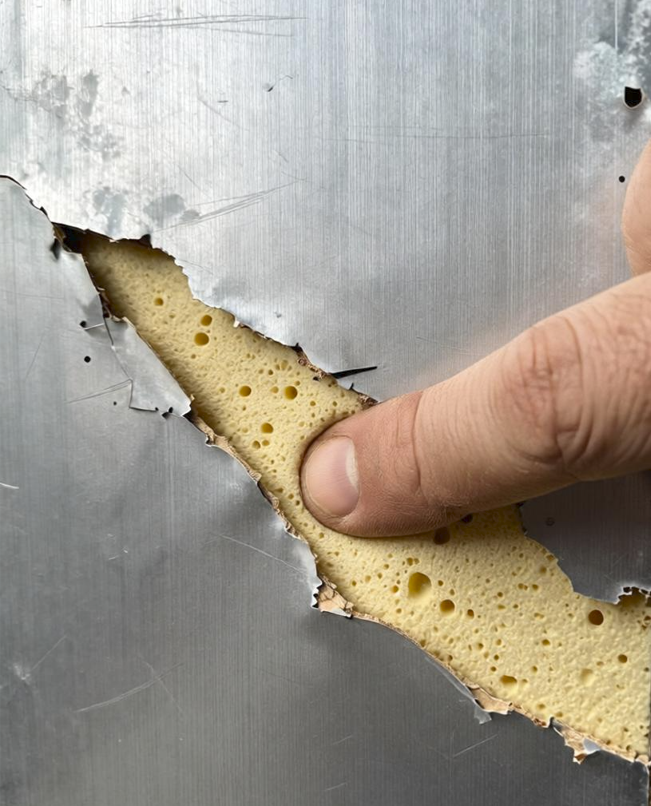
Corrosion is a serious concern
This is especially important for:
Cebu / coastal areas / ports / fish-processing facilities / marine environments / island projects.
We should focus on the following areas:
Galvanized coating thickness
PPGI coating
Paint system
Salt-spray performance
Stainless-steel options
Edge protection
For example: PPGI coatings include PE and PVDF coatings, with coating thicknesses ranging from 8 to 25; naturally, prices vary, as do the expected service lives of the coatings. If buyers focus solely on price and overlook these details, the PIR sandwich panels may corrode during use, leading to a reduction in the building’s overall thermal insulation performance.
Thickness of the epidermis
In the example above, thicknesses of 0.5 mm and 0.4 mm are difficult to detect and measure because, once the finished product is formed, the outer skin and core material are bonded together. A reduction in thickness not only lowers the strength of the PIR sandwich panel but also poses safety hazards during construction and use. At the same time, it compromises the product’s corrosion resistance, which in turn affects its thermal insulation performance. Although the price may be lower, the risks are greater.
Core Thickness
In the example above, although 95 mm is only slightly smaller than 100 mm, for PIR sandwich panels, this increases the material’s R-value, reduces the panel’s thermal insulation performance, and also reduces its moisture absorption capacity, which increases the risk of thermal bridging.
In actual deliveries, because it is difficult to accurately measure the thickness of sandwich panels, a 5-millimeter difference in thickness is very hard for buyers to detect, and it may leave them with a hidden risk that is difficult to notice.
Selecting an Adhesive
This is also an aspect that buyers often overlook. The adhesive accounts for approximately 10% to 15% of the cost of PIR sandwich panels, but it is crucial to ensuring that the panels function properly. It is the adhesive that bonds the two facings to the core material; if the adhesive is of poor quality, the facings may separate from the core during use, causing the panels to lose their functionality.
Buyers of PIR sandwich panel should pay close attention to the analysis above. Since many buyers lack specialized knowledge about PIR sandwich panels, we hope this article will help them better evaluate suppliers.