
Selection and Acceptance of Clean Transfer Window

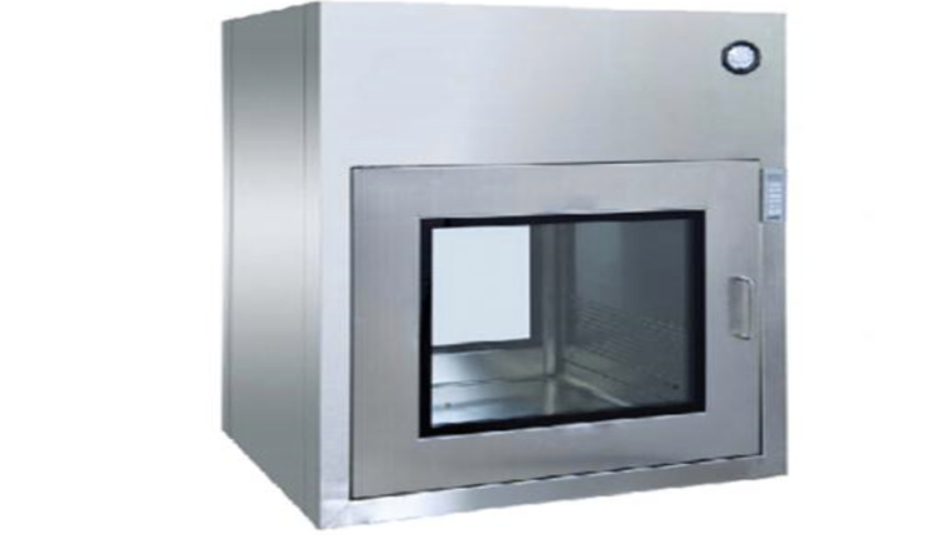
In a cleanroom, there is a simple yet crucial principle: people use air showers, while materials pass clean transfer window.
The reason is simple. The cleanliness of a cleanroom is painstakingly maintained through continuous airflow and the upkeep of a pressure differential. If doors were opened directly to move materials in and out, dust-laden air from outside would instantly rush in. Once the pressure differential is compromised, all the work done up to that point would be for nothing.
The clean transfer windows is an auxiliary device designed specifically to address this issue. Installed between clean zones or between a clean zone and a non-clean zone, it uses interlocking doors on both sides to ensure that neither door can be opened simultaneously. This prevents the flow of air between the inside and outside, thereby minimizing contamination caused by the transfer of materials.
Selection of Clean Transfer Window
A clean transfer windows is not a single product, but rather a product family. The higher the cleanliness level required, the greater the need for models with air purification capabilities. There are currently three types of clean transfer windows: standard clean transfer windows, air shower clean transfer windows, and laminar flow clean transfer windows.
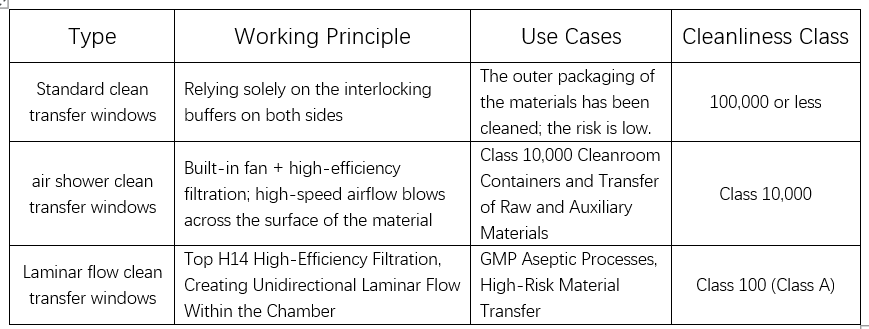
Differences Among the Three Types of clean transfer windows: The standard type addresses “isolation,” the air shower type addresses “dust removal,” and the laminar flow type addresses “sustained cleanliness protection.”
The internal cleanliness level of a laminar flow clean transfer windows can reach Class A (Class 100), with the cross-sectional air velocity typically controlled between 0.36 and 0.54 m/s; the air velocity at the nozzles of an air shower clean transfer windows can exceed 20 m/s, with a filtration efficiency of at least 99.99% for 0.3-micrometer particles.
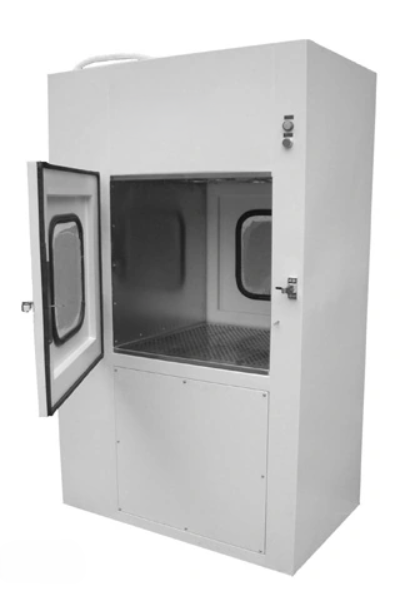
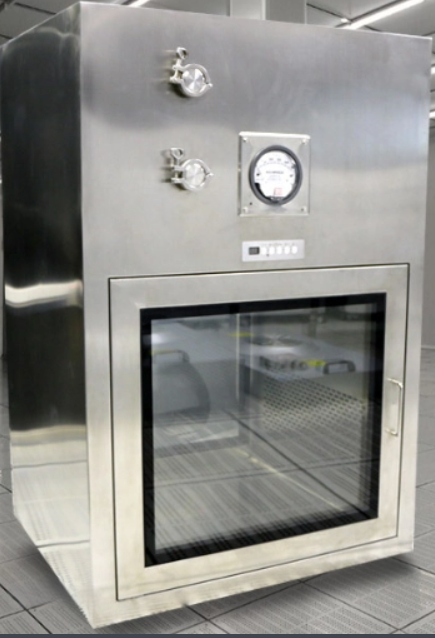
Five Parameters for Selecting Clean Transfer Window
When selecting a Clean Transfer Window, consider the following five parameters:
Internal Dimensions and Load Capacity
Determine this based on the outer packaging dimensions of the largest single item; a common internal cavity size is 600 × 600 × 600 mm. For palletized items, verify the load-bearing capacity of the base to avoid situations where “the opening is too small for the item,” which would force unpacking and result in secondary contamination.
Interlock Methods of Clean Transfer Window
Electronic interlocks respond quickly and can provide audible and visual alerts; mechanical interlocks have a simple design and a low failure rate. Regardless of the type, on-site testing must be conducted during acceptance inspection to ensure that both doors cannot be opened at the same time.
Material and Thickness of Clean Transfer Window
It is recommended that all surfaces in contact with the material be made of 304 stainless steel with a thickness of at least 1.0 mm; for high-cleanliness applications, 316L stainless steel with fully welded and polished joints may be used, with the air leakage rate controlled at ≤0.1%.
Purification Performance Metrics
For air shower-type cleanrooms, consider the air velocity at the nozzle outlet and the blow-off time (generally adjustable from 10 to 99 seconds); for laminar flow-type cleanrooms, consider the air velocity across the working area cross-section and the efficiency of the high-efficiency filter.
Additional Features
UV germicidal lamps (disinfection time typically 15–30 minutes), lighting, intercoms, and gravity-fed conveyor tables (for long-distance or heavy-load transport).
Acceptance Standards for Clean Transfer Window
When inspecting a Clean Transfer Window, be sure to follow these guidelines:
- Strictly enforce the “one open, one closed” rule: Both doors must not be open at the same time—this is non-negotiable.
- Don’t force the door open: For pass-through windows with interlocks, if one side won’t open, it’s often because the other side isn’t closed properly. Forcing it open can damage the interlock mechanism.
- Do not store any materials or debris inside the pass-through window—it is a passageway, not a storage area.
- When materials are transferred from a lower-level area to a higher-level area, ensure that the surfaces are cleaned first.
- Any malfunction of the interlock device must be repaired promptly; otherwise, the equipment cannot continue to be used.
- Regularly inspect the UV lamp (a consumable that requires periodic replacement), the door gaskets, and the pressure differential of the high-efficiency filter.
Clean Transfer Windows aren’t expensive, but a mistake in any stage—whether selection, installation, or operation—can cause the entire cleanroom line to “leak air.” Their value lies precisely in those invisible details.
The selection and acceptance of clean transfer windows play a crucial role in the construction and operation of cleanrooms. For such specialized tasks, it is best to choose a professional manufacturer. Please contact SDpanle for related inquiries.