
How to Select an Air Shower Based on Cleanroom Class

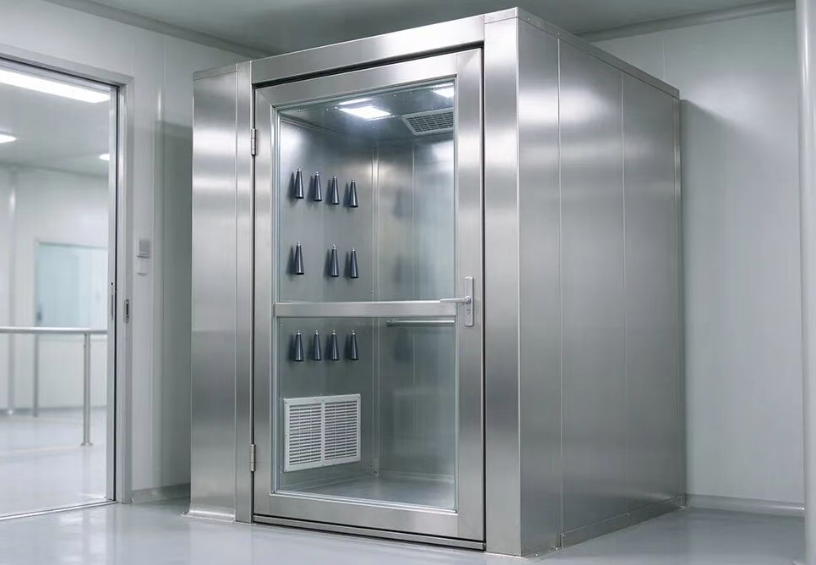
The choice of air shower varies depending on the cleanliness class of the cleanroom.
According to the ISO 14644-1 standard, cleanroom classifications are ranked such that the lower the number, the higher the cleanliness level. ISO 1–4 falls within the ultra-high-cleanliness range and is primarily used in the manufacturing of semiconductors and precision aerospace components; ISO 5–8 is the most commonly used range for industrial projects, including pharmaceuticals, medical devices, optics, and electronics assembly; ISO 9 is essentially equivalent to a standard factory environment and generally does not require a dedicated air shower—basic dust control measures are sufficient.
Selecting ISO Class 1–4 Air Shower
ISO Class 1–4 control standards are very strict and specify that airlock chambers should be used as personnel buffer zones whenever possible. If process conditions absolutely require the installation of an air shower, the unit should preferably be constructed of 316L stainless steel, equipped with a built-in H14 high-efficiency filter, and have an airflow velocity of ≥28 m/s and a shower duration of 25–30 seconds. The equipment must undergo a PAO leak test before shipment to prevent filter media leakage. In scenarios where a work crew exceeds five people, it is recommended to install a bypass emergency door to facilitate emergency evacuation. In such scenarios, the use of economical, simplified models is not recommended, as they can easily result in failure to meet cleanliness standards.
Selecting ISO Class 5 Air Shower
ISO Class 5 high-clean environments are commonly found in pharmaceutical sterile Zone A areas and semiconductor wafer fabrication facilities. Air showers typically feature a three-blow configuration, with the enclosure made of 304 or 316L stainless steel and equipped with H13–H14 high-efficiency filters. The airflow velocity is ≥27 m/s, and the shower duration is 20–25 seconds. Electronic interlocks are a mandatory requirement to prevent both the inner and outer doors from opening simultaneously, which could cause airflow backflow into the clean area. General guidelines: For shifts with up to 30 people, one single-person air shower is recommended; for projects with high foot traffic, an air shower corridor should be installed.
Selecting ISO Class 6-7 Air Shower
ISO Class 6–7 is currently the most common cleanliness class in projects and is widely used in medical device, active pharmaceutical ingredient (API), and optical assembly facilities. For air showers, we recommend the dual-blow model. The enclosure should preferably be made of 304 stainless steel, equipped with H13 high-efficiency filters, with a blow-off air velocity of ≥25 m/s and a blow-off duration of 15–20 seconds. Electronic interlocks are essential and should not be omitted. If the budget is tight, the enclosure may be made of powder-coated cold-rolled steel sheet, but the inner walls must be flat and smooth to prevent dust accumulation in hard-to-reach areas and meet GMP audit requirements.
Selecting ISO Class 8 Air Shower
ISO-class cleanrooms are considered standard cleanrooms, and their specifications can be appropriately relaxed. A dual-blow air shower is generally sufficient, equipped with an H13 high-efficiency filter, with an airflow velocity controlled at 23–25 m/s and a blow-off time of 12–15 seconds. The enclosure may be made of powder-coated cold-rolled steel, but electronic interlocks must still be included. For small laboratories with very few personnel, an airlock combined with a dust-trapping mat may be used as an alternative after conducting a risk assessment; however, this approach is not recommended for production facilities.
Selecting ISO Class 9 Air Shower
ISO Class 9 cleanrooms have an environment similar to that of standard factory facilities, so there is no mandatory requirement to install an air shower. Basic dust control measures, such as changing shoes and cleanroom garments, are sufficient.
When selecting an air shower, one should not simply compare prices and appearances while neglecting the HEPA filter rating, actual air velocity, and overall unit sealing. An air shower is merely a dust-removal buffer for personnel; filtration capacity is the key to effective dust removal.
SDpanel has many years of experience in cleanroom engineering, is ISO 9001 certified, and possesses extensive technical expertise in cleanroom systems. As an industry leader in the design, materials technology, and manufacturing processes of cleanroom enclosure systems, the company is committed to providing comprehensive cleanroom enclosure system solutions that deliver unique value to clients across various industries.