
Why do some PIR sandwich panels have massive condensation issues while others don’t

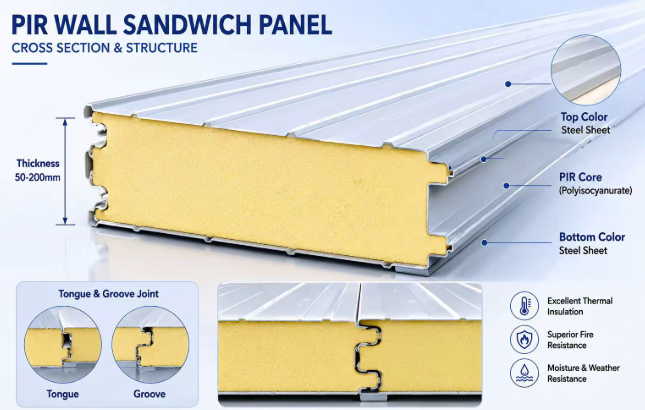
PIR sandwich panels are a high-performance thermal insulation material; their closed-cell structure results in an extremely low water absorption rate (typically <0.5%) and excellent resistance to water vapor penetration.
Whether PIR sandwich panels will experience severe condensation issues does not stem from the PIR material itself, but rather from numerous details throughout the entire process—from product selection to design, installation, and use.
Design and Installation Defects
This is the most common cause of condensation problems.
Thermal bridges:Cold spots can form at fasteners, steel frames, purlins, eaves, ridge joints, penetration points, and the connections between walls and roofs. If condensation is concentrated in a straight line or appears around screws or joints, this is usually a clear sign of a thermal bridge issue.
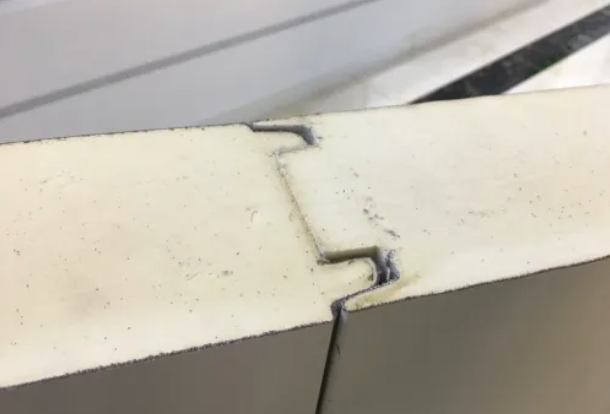
Joint and Seal Failures: If the seams between panels, corners, and pipe penetrations are not properly sealed, warm, humid air will seep in. When this moisture comes into contact with the cool PIR core inside, condensation will form directly within the cavity or on the inner surface.
Joint and Seal Failures: If the seams between panels, corners, and pipe penetrations are not properly sealed, warm, humid air will seep in. When this moisture comes into contact with the cool PIR core inside, condensation will form directly within the cavity or on the inner surface.
Quality of Sandwich Panel Sheets and Core Materials
Substandard PIR Sandwich Panels: Low-quality PIR sandwich panels may suffer from issues such as low closed-cell foam content, large pores, and uneven density. This can lead to an increase in thermal conductivity and a significant decline in thermal insulation performance, making them unable to effectively block the transfer of heat and cold, which in turn causes widespread, uniform condensation.
Insufficient sandwich panel thickness: The thickness of the insulation layer is key to determining whether the surface temperature can be maintained above the dew point. If the thickness is calculated incorrectly or is insufficient, the surface temperature is likely to fall below the dew point, resulting in condensation.
Environmental and Operating Conditions for PIR Sandwich Panels
High-humidity environments: In humid regions—such as coastal or tropical areas—or in settings where indoor humidity is inherently high (e.g., data centers or cold storage facilities), the air contains significant water vapor, making condensation on cold surfaces more likely.
Poor Ventilation: If PIR sandwich panels are installed in an enclosed space with poor ventilation (such as inside a dropped ceiling), moisture cannot escape, which increases the risk of condensation.
In summary, condensation issues with PIR sandwich panels are a systemic problem. High-quality PIR material is the foundation, but what truly determines success or failure is every detail—from design to installation.