
How to Choose Cold Storage Panels

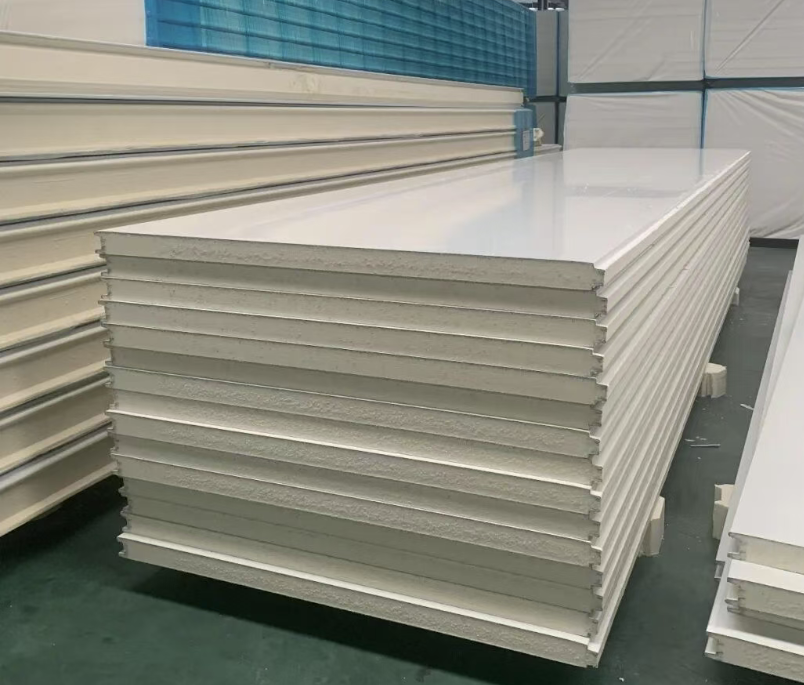
For cold storage owners, constructing a facility that meets cold chain standards while remaining cost-effective requires considerable effort. As the outer shell of the facility, cold storage panels play a critical role. The choice of cold storage panels depends on the following four factors.
Choosing the Core Material for Cold Storage Panels: PU or PIR
Polyurethane panels are generally chosen for cold storage facilities. The core material actually comes in two types: standard rigid polyurethane foam (PU) and modified polyisocyanurate (PIR). PU cold storage panels offer superior thermal insulation, the lowest thermal conductivity, and manageable costs, making them fully adequate for standard fresh-keeping, refrigerated, and frozen storage facilities. PIR cold storage panels are modified versions of PU panels, offering better temperature resistance, flame retardancy, and dimensional stability. They are less prone to collapse at high temperatures, produce low smoke emissions when burning, and provide greater safety in the event of a fire.
Density of Cold Storage Panels: The Key to Insulation and Strength
The density of cold storage panels refers to the amount of polyurethane foam per unit volume, which directly determines thermal insulation performance, compressive strength, and panel surface flatness. If the density is too low, the panels will not retain temperature effectively, no matter how thick they are. Standards require a foam density of no less than 35 kg/m³; SDpanel cold storage panels typically have a density ranging from 38 to 42 kg/m³. For deep-freeze and quick-freeze facilities, a density of 45 kg/m³ or higher is recommended, while ultra-low-temperature (-60°C) applications require a density of 50 kg/m³.
Thermal Conductivity and Closed-Cell Content of Cold Storage Panels: The Two Pillars of Thermal Insulation
At a density of 35–40 kg/m³, rigid polyurethane foam has a thermal conductivity of approximately 0.018–0.023 W/(m·K), which is about half that of EPS and the lowest among mainstream insulation materials. With a closed-cell rate of over 90%, its closed-cell structure prevents water vapor from penetrating, ensuring it will not fail due to moisture absorption. The impact of the closed-cell rate varies by region; in tropical, high-humidity areas such as Southeast Asia, the Middle East, and South America, water vapor penetration is the leading cause of insulation failure, so the closed-cell rate and moisture resistance must be specified as mandatory requirements.
Cold Storage Panel Thickness: Matched to Temperature Zones
Different cold storage facilities require different types of cold storage panels. For fresh-keeping warehouses (0–5°C), use 50–75mm-thick cold storage panels; for refrigerated warehouses (-10–0°C), use 100mm-thick cold storage panels; for frozen warehouses (-18°C), use 100–120mm-thick cold storage panels; For cryogenic cold storage (-25–30°C), 150mm-thick panels are used; for quick-freezing and ultra-low-temperature cold storage (below -35°C), 200mm-thick panels with high-density core material are used.
Note: The thickness of cold storage panels is determined based on local energy efficiency standards; it should not be reduced or increased arbitrarily. Reducing the panel thickness may prevent the system from reaching the designed temperature, while thicker panels are heavier, leading to higher shipping and installation costs.
Surface Materials and Coatings for Cold Storage Panels
The facing material for cold storage panels is typically color-coated steel sheet, with the base sheet available in galvanized or aluminum-zinc-coated varieties; common thicknesses range from 0.4 to 0.6 millimeters. In applications with high hygiene requirements, such as food processing and pharmaceuticals, stainless steel sheets are used instead. Aluminum-zinc-coated steel (with an aluminum content of approximately 55%) offers significantly better corrosion resistance than pure galvanized steel and is the preferred choice for coastal and high-humidity regions.
Selecting cold storage panels requires determining the density and thickness based on the storage temperature and climate, choosing the facing material and coating, and finally establishing the delivery schedule.